Packet Radio - Digital Emergency Communication via Amateur Radio
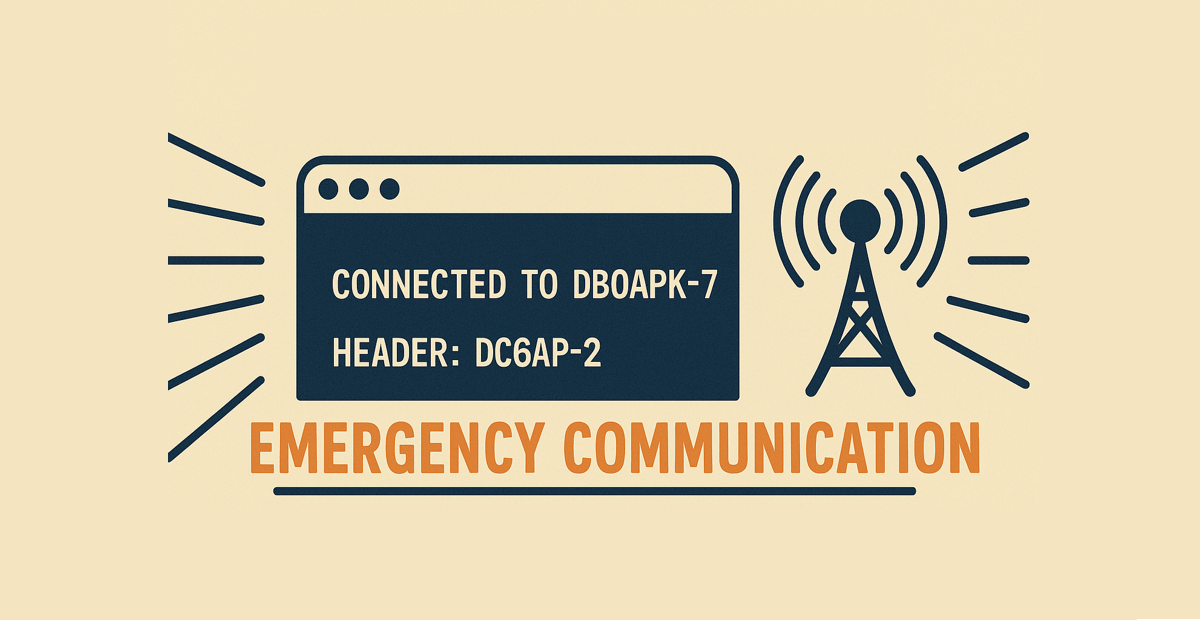
In an increasingly digital world, our communication is highly dependent on centralized infrastructure. But what happens when the internet or mobile networks fail? In exactly such situations, packet radio offers a reliable, decentralized solution for text-based data communication – without any existing networks.
This article explains how packet radio can serve as an emergency communication tool, what equipment is needed, and why it’s particularly relevant for amateur radio operators, engineers, and preppers.
What is Packet Radio?
Packet radio is a digital communication mode in amateur radio where information is transmitted in small “packets” (frames) over radio waves. It’s based on the AX.25 protocol, which is derived from the commercial X.25 networking protocol, adapted for amateur use.
Unlike voice communication, packet radio transmits pure data – such as messages, status updates, coordinates, or weather data. These packets are encoded, sent, received, and automatically acknowledged – similar to email, but without the internet.
Why is Packet Radio Ideal for Emergencies?
Packet radio is perfectly suited for disaster and emergency scenarios, especially when:
- Internet or mobile service is unavailable
- Power supply is disrupted
- Infrastructure is damaged or inaccessible
Key Advantages in Emergencies:
✅ Completely independent of centralized infrastructure
✅ Operable on battery, solar, or other off-grid power
✅ Decentralized network structure via digipeaters (data repeaters)
✅ Resilient to interference and signal degradation
✅ Store-and-forward capability for asynchronous communication
How It Works: The Technology Behind Packet Radio
1. AX.25 Protocol
This protocol handles addressing, error checking, and packet structure. Each data frame includes the call signs of sender and receiver and can be relayed automatically by other stations.
2. Modulation & Data Rates
- 1200 baud – on VHF (2 m band) using AFSK
- 9600 baud – on UHF (70 cm band) using G3RUH modulation
- 300 baud – on HF (shortwave), ideal for long-distance
3. Hardware Setup
To set up a basic emergency station, you’ll need:
- A radio transceiver (e.g., 2 m or 70 cm handheld)
- A modem – either a classic TNC (Terminal Node Controller) or a software modem like Direwolf
- A computer – PC, Raspberry Pi, or even a tablet with audio interface
- An antenna – preferably portable (telescopic whip, mag-mount, etc.)
- A power source – battery, power bank, or solar panel
4. Digipeaters & Networks
Any station can act as a “digipeater,” automatically relaying received packets. This allows long-range communication even without line-of-sight – critical in rugged terrain or across distances.
Practical Use Cases in Emergencies
Packet radio is well suited for:
- 📡 Team coordination in isolated or disaster-affected areas
- 📝 Transmitting status updates, weather, or medical data
- 📍 Sending GPS coordinates
- 💾 Sharing small files or lists
- 🔁 Reliable, asynchronous message transfer
Even if a station is only reachable intermittently, messages can be stored and forwarded later. The store & forward principle ensures robust, time-independent communication.
Packet Radio for Preppers & Self-Reliant Communicators
Anyone preparing for emergency situations should consider including packet radio in their communication plan.
Advantages for preparedness:
- Requires minimal equipment
- Does not rely on the internet
- Works during blackouts
- Discreet, efficient data exchange
- Usable worldwide on amateur bands
- Can be combined with APRS (automated position/status reporting)
A compact setup fits in a go-bag – including a handheld radio, small antenna, power bank, and a Raspberry Pi.
Getting Started
You’ll need:
- An amateur radio license (e.g., Technician or equivalent)
- Basic equipment:
- A transceiver with a data or mic port
- A sound modem (e.g., USB sound card + Direwolf)
- Software like FlexPacket, LinPac, UZ7HO, Xastir, or Paxon
- A suitable frequency (e.g., 144.800 MHz in Europe for APRS or 144.950 / 438.400 MHz for packet)
- A little time and patience to configure and test
Conclusion
Packet radio is more than a relic from the ’90s – it’s a robust, infrastructure-independent digital network that shines in emergencies. For amateur radio operators, makers, and preppers, it offers a real-world solution to communicate when all else fails – whether locally or across regions via relays.
💬 Packet radio stays online – even when the world goes offline.